
Once again, we are back with the 2023 Edition of Playoff Trivia! I don’t think my opinions of the twelve-team format have shifted very much over the last year, even after the 2022 postseason, so if you want to see what those were again, you’re welcome to check it out over here. If my thoughts are at all different, it might be that the new system might need to do some re-seeding for the second round?
I more or less made my peace last year with the idea that the team with the second-best record in a League might be ignored for a bye because they were a wild card team rather than a division winner. Maybe awarding byes purely on record would be a little better, but as long as the worst division winners were also being denied a bye, this system probably balances out a little by at least denying the dumbest cases (like a .500-Division Winner getting a bye in the place of a 100-win Wild Card).
But it does seem a little weird that the default bracket right now automatically has the best wild card team face off against the #1 seed in the league in the division round. It seems odd that the top team’s “reward” for their success will fairly often be “facing the second-best record in the Division Series”. And even leaving aside what the top seed “deserves” for their success, it also might make more sense to use a system that reserves that sort of “clash of the titans” meeting for the Championship Series round?
But overall, yeah, I still enjoy this more than the old five team system, and we will probably just have to wait and see if this becomes a recurring issue. With all that said, we can probably jump into the trivia!
DROUGHTS
Despite the fact that the last three World Series winners make up a quarter of the postseason field in 2023, this year’s drought breakdown is generally in-line with last year’s field, if not slightly more geared towards long-suffering teams.

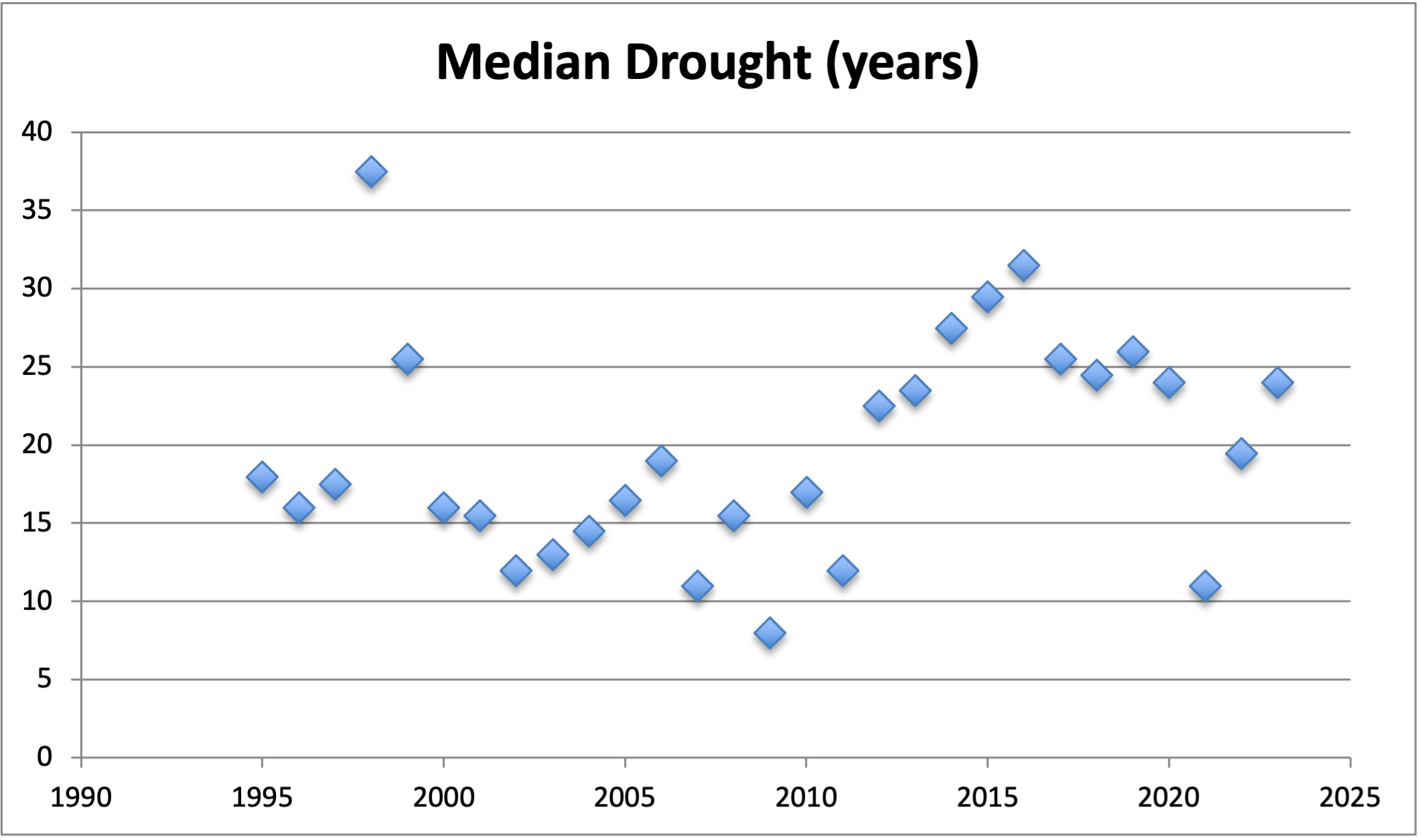
In fact, the Phillies are actually the fourth most-recent winners here, despite breaking a decade-long playoff drought just last year. The Marlins, who last won it all twenty years ago in 2003 and have only returned to the postseason once in the interim (the shortened 2020 season), still represent the fifth most recent winners, while half of the field has not won it all since the turn of the millennium (if at all).
That all-around balance is part of how we managed to match last year’s average, despite losing the active leaders for longest drought, the Guardians. The Rangers and Brewers (who have never won) more than covered for losing the similarly-titleless Padres and Mariners; in net, those changes were just swapping the fifth-longest drought for the second-longest one (with the Padres and Brewers being tied for third-longest). And Baltimore is in seventh place (and hitting the fortieth anniversary of their most recent title this year), all of which goes to explain why we stayed consistent in average. Also of note, the pair of teams making up the median this time are 1998 expansion mates the Diamondbacks (won in 2001) and the Rays (no wins).
Looking into it a little more, it’s actually kind of shocking that having all 3 of the Astros, Braves, and Dodgers didn’t ruin the numbers here. In the Wild Card era, only two other playoffs featured three unique teams who have won in the last three years, 2009 (Cardinals, Red Sox, and Phillies) and 2012 (Yankees, Giants, and Cardinals). You can easily pick out 2009 on those charts above, it’s the year that’s way below everything else. 2012 avoided a similar fate in a way similar to this year, making sure there were a lot of 30-to-50 year droughts to balance out all of the recent winners. If it weren’t for the absence of a lot of familiar October faces this year, we’d probably be much closer to 2009 here (but we’ll get into that later).
Of course, for the pessimists, you could just point out that those last three winners make up 3 of our 4 first round byes, which limits our chances of a major drought ending a little; but there’s enough randomness here that it’s not a given that one of them storms to a repeat.
PLAYERS WITHOUT A WORLD SERIES
Once again, after the World Series ends, I’ll be posting another edition of my Sporcle quiz on the Best Active Players Without a World Series with the new winners removed. For anyone who doesn’t want to know any of the players going into it, I’ll just include how many of them will be playing in October, and for which teams. If you’d like to know who specifically you can root for, though, I’ll include a Spoilers section at the end of this piece with names. We’ve got a pretty wide range this year: Toronto leads the way with a full five names, and Milwaukee and Philadelphia are right on their heels. The young Orioles and Rays are the only teams totally unrepresented, but even then, a win this year will prevent some of their young stars from appearing on lists down the line.
None: Orioles, Rays
One: Astros, Braves, Dodgers, Marlins
Two: Rangers
Three: Diamondbacks, Twins
Four: Brewers, Phillies
Five: Blue Jays
THREE-TEAM WATCH
After its debut in last season’s column, I’ve decided to make this section a regular part of the series! As a quick recap, we’re looking here for players who have won a World Series with multiple teams, to see if anyone is poised to tie the record of winning with three different teams (currently held by seventeen players).
And this year, we actually do have a few players trying to tie that record! Christian Vazquez (2018 Red Sox) and Will Smith (2021 Braves) both picked up their second title last year as deadline acquisitions for the Astros, and then joined new teams as free agents. And now, both the Twins and Rangers will be playing in October. Additionally, Smith last year became just the tenth player in history to win titles with two different teams in back-to-back seasons, so a third straight team-and-title will obviously be all kinds of historic. On top of that, thanks to the Marlins’ dark horse run at the title, Jorge Soler (2016 Cubs, 2021 Braves) will also be trying for his third unique championship team.
Outside of them, there are a few players going for their second title on a new team, although there are enough of them that listing every single name would be tedious. Some highlights:
-There are plenty of stars who have previously won on new teams this year, including Brandon Belt (2012, 2014 Giants) on the Blue Jays, Trea Turner (2019 Nationals) and Craig Kimbrel (2018 Red Sox) on the Phillies, J.D. Martinez (2018 Red Sox) on the Dodgers, and Max Scherzer (2019 Nationals) on the Rangers.
-Of course, you also have a few other recent movers who have not won on their new teams, like Freddie Freeman (2021 Braves) and Jason Heyward (2016 Cubs) on the Dodgers, and Corey Seager (2020 Dodgers) and Nathan Eovaldi (2018 Red Sox) on the Rangers. Brewers’ catcher William Contreras (2021 Braves) might be the most interesting name in this group, since he’s a young star who isn’t even eligible for arbitration yet. Still obviously a long way to go there, though.
-For any Crawfish Boxes readers, the Astros don’t really bring any new names to the table, since they won last year and their biggest acquisitions this year were all players without titles. However, there are a number of ex-Astros gunning for this list, including: George Springer on the Blue Jays, Collin McHugh on the Braves, Yuli Gurriel on the Marlins, plus Carlos Correa and Dallas Keuchel on the Twins with Vazquez.
EXPANSION TEAMS
Once again, with seven expansion teams playing in October, our chance at seeing just the third ever all-expansion-team World Series (following 2015 and 2019) is looking pretty good! That’s been the case for the last few years, though, to no avail, so let’s not get ahead of ourselves just yet.
As has been the case the last few years, the AL side of the equation looks very promising. Four out of six teams* (the Rays, Blue Jays, Rangers, and Astros) are expansion teams. It’s not a full 2-in-3 chance, though, since there are byes involved; if you assume coin flips for every series (not a bad simple estimate, given baseball’s randomness) the odds are a little closer to 5-in-8.
*And really, even though we won’t count them here, even our two non-expansion teams (the Orioles and Twins) kind of feel like expansion teams; both of them relocated right around the start of the expansion era while completely rebranding to distance themselves from years of futility (as the St. Louis Browns and first Washington Senators, respectively). Since neither of them really acknowledges their history prior to their moves, it does kind of make it feel like they just suddenly appeared, much like the expansion teams.
That bye system is what makes the NL side of the equation, as usual, look a lot less promising. While there are three expansion teams over there, the Dodgers and Braves (both original teams) have locked up the byes. In practice, that means our basic odds are a lot closer to 3-in-8 (and that estimate only goes down if you give the Dodgers and Braves more advantages to reflect their 100-win seasons).
If you want to combine those, our chances here are maybe closer to 15-in-64 or worse, or a little under 1-in-4. So not great, but then again, that still does beat the chances we were seeing in 2019; anything can happen here!
Also, I’ll note here that the Astros, Blue Jays, and Marlins will all be gunning to become the first Expansion Team with three titles, while the Diamondbacks will be trying to become just the sixth one (out of fourteen in all) with two titles.
UNIQUE MATCHUPS
The 2023 postseason will be the first playoff without the Yankees, Red Sox, or Cardinals since 1993; that was literally the last year before the Wild Card was added, back when only four teams total made the postseason. So as you might imagine, with those three out of the picture, we have several opportunities for some different matchups!
But not too many. After all, the Braves and Dodgers, quite the October regulars themselves, are still here. And the Phillies have actually met a majority of these AL teams in a championship, despite their relatively smaller number of pennants. The rest of the NL field is a total blank slate, though.
On the AL side of things, these distributions are much more even: the Orioles, Rays, Blue Jays, and Twins have all met exactly two potential NL opponents, while the Astros are at three. Only the Rangers stand out, having faced none of the six NL teams playing in October.
One of the more interesting things about this set of teams is that, despite the fact that a third of these potential match-ups have happened before, none of them have happened more than once. That is actually pretty rare, and this is where the relatively young set of AL teams comes in clutch. The oldests of these rematches only goes back to the 1960s (Twins-Dodgers in 1965, with the Orioles-Dodgers coming the next year). We also have every series from 1991 to 1993 represented, plus the last three World Series.
As far as interesting potential new match-ups? Off the top of my head, Orioles-Braves and Twins-Phillies are both match-ups of original-16 teams that still haven’t happened. Brewers versus either the Rays or the Rangers would give us our first match-up of two teams without titles since 1980 (and only the third time this has happened going back all the way to 1910*). Blue Jays versus Diamondbacks or Marlins would mean one of those teams would pick up their first World Series loss ever. And if the Astros find themselves facing off against Miami, it would be their fourth different NL East World Series opponent in five years.
*Five of the first six World Series were between two titleless teams, and it’s happened only twice since then, 1920 and 1980.
| rematches | ATL | MIL | LAD | PHI | MIA | MIL |
|---|---|---|---|---|---|---|
| BAL | X | X | ||||
| MIN | X | X | ||||
| HOU | X | X | X | |||
| TBR | X | X | ||||
| TEX | ||||||
| TOR | X | X |
Rematches
Twins-Dodgers (1965)
Orioles-Dodgers (1966)
Orioles-Phillies (1983)
Twins-Braves (1991)
Blue Jays-Braves (1992)
Blue Jays-Phillies (1993)
Rays-Phillies (2008)
Astros-Dodgers (2017)
Rays-Dodgers (2020)
Astros-Braves (2021)
Astros-Phillies (2022)
BEST PLAYERS WITHOUT A WORLD SERIES, BY TEAM (SPOILERS)
