Mailing List

Sign up for email updates from Hot Corner Harbor any time there's a new post!

    Showing posts with label Wild Cards. Show all posts
    Showing posts with label Wild Cards. Show all posts

    Monday, October 2, 2023

    Return of the Yearly Postseason Trivia Rundown, 2023 Edition

    Once again, we are back with the 2023 Edition of Playoff Trivia! I don’t think my opinions of the twelve-team format have shifted very much over the last year, even after the 2022 postseason, so if you want to see what those were again, you’re welcome to check it out over here. If my thoughts are at all different, it might be that the new system might need to do some re-seeding for the second round?


    I more or less made my peace last year with the idea that the team with the second-best record in a League might be ignored for a bye because they were a wild card team rather than a division winner. Maybe awarding byes purely on record would be a little better, but as long as the worst division winners were also being denied a bye, this system probably balances out a little by at least denying the dumbest cases (like a .500-Division Winner getting a bye in the place of a 100-win Wild Card).

    But it does seem a little weird that the default bracket right now automatically has the best wild card team face off against the #1 seed in the league in the division round. It seems odd that the top team’s “reward” for their success will fairly often be “facing the second-best record in the Division Series”. And even leaving aside what the top seed “deserves” for their success, it also might make more sense to use a system that reserves that sort of “clash of the titans” meeting for the Championship Series round?

    But overall, yeah, I still enjoy this more than the old five team system, and we will probably just have to wait and see if this becomes a recurring issue. With all that said, we can probably jump into the trivia!


    DROUGHTS

    Despite the fact that the last three World Series winners make up a quarter of the postseason field in 2023, this year’s drought breakdown is generally in-line with last year’s field, if not slightly more geared towards long-suffering teams.

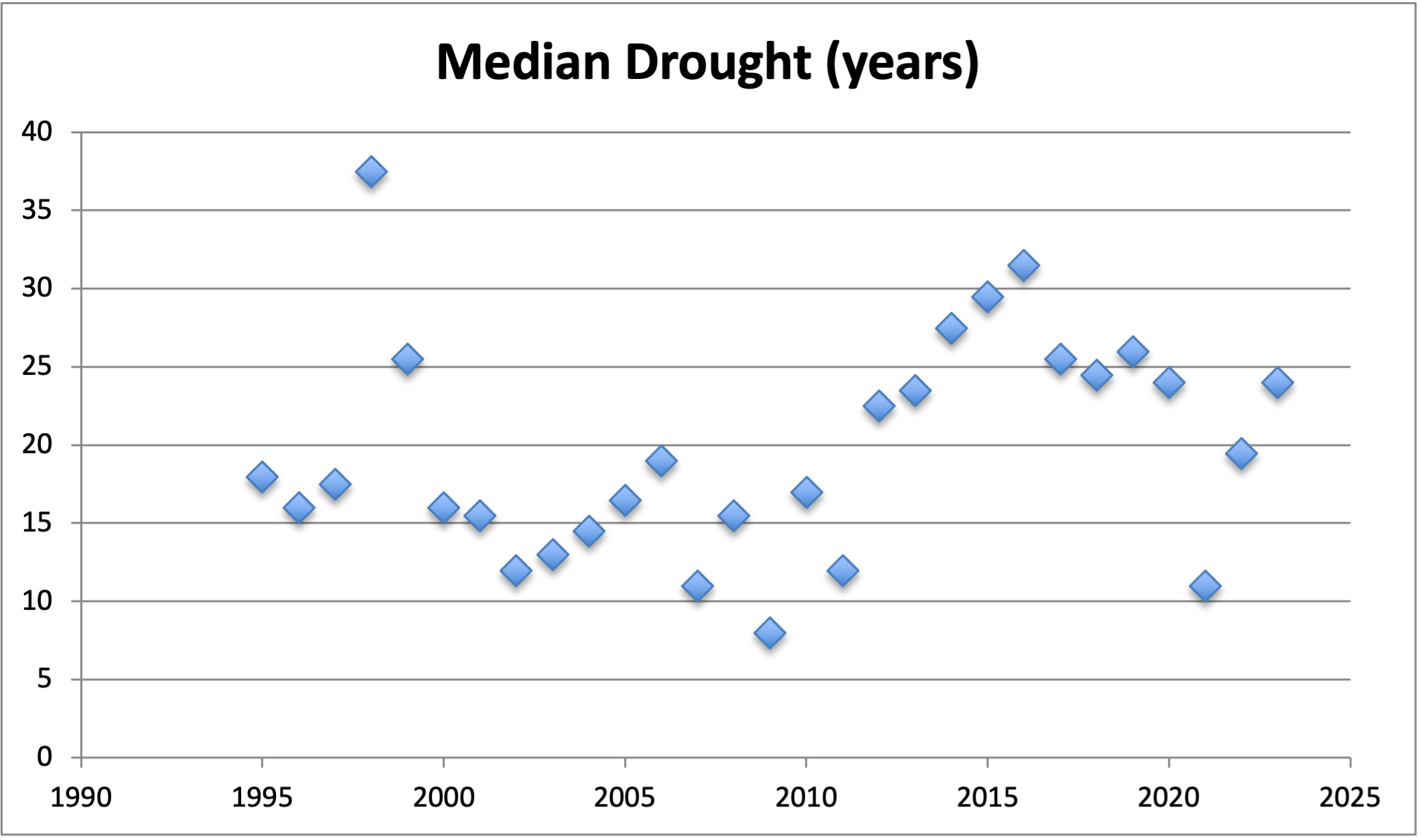
    In fact, the Phillies are actually the fourth most-recent winners here, despite breaking a decade-long playoff drought just last year. The Marlins, who last won it all twenty years ago in 2003 and have only returned to the postseason once in the interim (the shortened 2020 season), still represent the fifth most recent winners, while half of the field has not won it all since the turn of the millennium (if at all).

    That all-around balance is part of how we managed to match last year’s average, despite losing the active leaders for longest drought, the Guardians. The Rangers and Brewers (who have never won) more than covered for losing the similarly-titleless Padres and Mariners; in net, those changes were just swapping the fifth-longest drought for the second-longest one (with the Padres and Brewers being tied for third-longest). And Baltimore is in seventh place (and hitting the fortieth anniversary of their most recent title this year), all of which goes to explain why we stayed consistent in average. Also of note, the pair of teams making up the median this time are 1998 expansion mates the Diamondbacks (won in 2001) and the Rays (no wins).

    Looking into it a little more, it’s actually kind of shocking that having all 3 of the Astros, Braves, and Dodgers didn’t ruin the numbers here. In the Wild Card era, only two other playoffs featured three unique teams who have won in the last three years, 2009 (Cardinals, Red Sox, and Phillies) and 2012 (Yankees, Giants, and Cardinals). You can easily pick out 2009 on those charts above, it’s the year that’s way below everything else. 2012 avoided a similar fate in a way similar to this year, making sure there were a lot of 30-to-50 year droughts to balance out all of the recent winners. If it weren’t for the absence of a lot of familiar October faces this year, we’d probably be much closer to 2009 here (but we’ll get into that later).

    Of course, for the pessimists, you could just point out that those last three winners make up 3 of our 4 first round byes, which limits our chances of a major drought ending a little; but there’s enough randomness here that it’s not a given that one of them storms to a repeat.


    PLAYERS WITHOUT A WORLD SERIES

    Once again, after the World Series ends, I’ll be posting another edition of my Sporcle quiz on the Best Active Players Without a World Series with the new winners removed. For anyone who doesn’t want to know any of the players going into it, I’ll just include how many of them will be playing in October, and for which teams. If you’d like to know who specifically you can root for, though, I’ll include a Spoilers section at the end of this piece with names. We’ve got a pretty wide range this year: Toronto leads the way with a full five names, and Milwaukee and Philadelphia are right on their heels. The young Orioles and Rays are the only teams totally unrepresented, but even then, a win this year will prevent some of their young stars from appearing on lists down the line.


    None: Orioles, Rays
    One: Astros, Braves, Dodgers, Marlins
    Two: Rangers
    Three: Diamondbacks, Twins
    Four: Brewers, Phillies
    Five: Blue Jays


    THREE-TEAM WATCH

    After its debut in last season’s column, I’ve decided to make this section a regular part of the series! As a quick recap, we’re looking here for players who have won a World Series with multiple teams, to see if anyone is poised to tie the record of winning with three different teams (currently held by seventeen players).

    And this year, we actually do have a few players trying to tie that record! Christian Vazquez (2018 Red Sox) and Will Smith (2021 Braves) both picked up their second title last year as deadline acquisitions for the Astros, and then joined new teams as free agents. And now, both the Twins and Rangers will be playing in October. Additionally, Smith last year became just the tenth player in history to win titles with two different teams in back-to-back seasons, so a third straight team-and-title will obviously be all kinds of historic. On top of that, thanks to the Marlins’ dark horse run at the title, Jorge Soler (2016 Cubs, 2021 Braves) will also be trying for his third unique championship team.

    Outside of them, there are a few players going for their second title on a new team, although there are enough of them that listing every single name would be tedious. Some highlights:

    -There are plenty of stars who have previously won on new teams this year, including Brandon Belt (2012, 2014 Giants) on the Blue Jays, Trea Turner (2019 Nationals) and Craig Kimbrel (2018 Red Sox) on the Phillies, J.D. Martinez (2018 Red Sox) on the Dodgers, and Max Scherzer (2019 Nationals) on the Rangers.

    -Of course, you also have a few other recent movers who have not won on their new teams, like Freddie Freeman (2021 Braves) and Jason Heyward (2016 Cubs) on the Dodgers, and Corey Seager (2020 Dodgers) and Nathan Eovaldi (2018 Red Sox) on the Rangers. Brewers’ catcher William Contreras (2021 Braves) might be the most interesting name in this group, since he’s a young star who isn’t even eligible for arbitration yet. Still obviously a long way to go there, though.

    -For any Crawfish Boxes readers, the Astros don’t really bring any new names to the table, since they won last year and their biggest acquisitions this year were all players without titles. However, there are a number of ex-Astros gunning for this list, including: George Springer on the Blue Jays, Collin McHugh on the Braves, Yuli Gurriel on the Marlins, plus Carlos Correa and Dallas Keuchel on the Twins with Vazquez.


    EXPANSION TEAMS

    Once again, with seven expansion teams playing in October, our chance at seeing just the third ever all-expansion-team World Series (following 2015 and 2019) is looking pretty good! That’s been the case for the last few years, though, to no avail, so let’s not get ahead of ourselves just yet.

    As has been the case the last few years, the AL side of the equation looks very promising. Four out of six teams* (the Rays, Blue Jays, Rangers, and Astros) are expansion teams. It’s not a full 2-in-3 chance, though, since there are byes involved; if you assume coin flips for every series (not a bad simple estimate, given baseball’s randomness) the odds are a little closer to 5-in-8.

    *And really, even though we won’t count them here, even our two non-expansion teams (the Orioles and Twins) kind of feel like expansion teams; both of them relocated right around the start of the expansion era while completely rebranding to distance themselves from years of futility (as the St. Louis Browns and first Washington Senators, respectively). Since neither of them really acknowledges their history prior to their moves, it does kind of make it feel like they just suddenly appeared, much like the expansion teams.

    That bye system is what makes the NL side of the equation, as usual, look a lot less promising. While there are three expansion teams over there, the Dodgers and Braves (both original teams) have locked up the byes. In practice, that means our basic odds are a lot closer to 3-in-8 (and that estimate only goes down if you give the Dodgers and Braves more advantages to reflect their 100-win seasons).

    If you want to combine those, our chances here are maybe closer to 15-in-64 or worse, or a little under 1-in-4. So not great, but then again, that still does beat the chances we were seeing in 2019; anything can happen here!

    Also, I’ll note here that the Astros, Blue Jays, and Marlins will all be gunning to become the first Expansion Team with three titles, while the Diamondbacks will be trying to become just the sixth one (out of fourteen in all) with two titles.


    UNIQUE MATCHUPS

    The 2023 postseason will be the first playoff without the Yankees, Red Sox, or Cardinals since 1993; that was literally the last year before the Wild Card was added, back when only four teams total made the postseason. So as you might imagine, with those three out of the picture, we have several opportunities for some different matchups!

    But not too many. After all, the Braves and Dodgers, quite the October regulars themselves, are still here. And the Phillies have actually met a majority of these AL teams in a championship, despite their relatively smaller number of pennants. The rest of the NL field is a total blank slate, though.

    On the AL side of things, these distributions are much more even: the Orioles, Rays, Blue Jays, and Twins have all met exactly two potential NL opponents, while the Astros are at three. Only the Rangers stand out, having faced none of the six NL teams playing in October.

    One of the more interesting things about this set of teams is that, despite the fact that a third of these potential match-ups have happened before, none of them have happened more than once. That is actually pretty rare, and this is where the relatively young set of AL teams comes in clutch. The oldests of these rematches only goes back to the 1960s (Twins-Dodgers in 1965, with the Orioles-Dodgers coming the next year). We also have every series from 1991 to 1993 represented, plus the last three World Series.

    As far as interesting potential new match-ups? Off the top of my head, Orioles-Braves and Twins-Phillies are both match-ups of original-16 teams that still haven’t happened. Brewers versus either the Rays or the Rangers would give us our first match-up of two teams without titles since 1980 (and only the third time this has happened going back all the way to 1910*). Blue Jays versus Diamondbacks or Marlins would mean one of those teams would pick up their first World Series loss ever. And if the Astros find themselves facing off against Miami, it would be their fourth different NL East World Series opponent in five years.

    *Five of the first six World Series were between two titleless teams, and it’s happened only twice since then, 1920 and 1980.


    rematches ATL MIL LAD PHI MIA MIL
    BAL

    X X

    MIN X
    X


    HOU X
    X X

    TBR

    X X

    TEX


    TOR X

    X


    Rematches
    Twins-Dodgers (1965)
    Orioles-Dodgers (1966)
    Orioles-Phillies (1983)
    Twins-Braves (1991)
    Blue Jays-Braves (1992)
    Blue Jays-Phillies (1993)
    Rays-Phillies (2008)
    Astros-Dodgers (2017)
    Rays-Dodgers (2020)
    Astros-Braves (2021)
    Astros-Phillies (2022)


    BEST PLAYERS WITHOUT A WORLD SERIES, BY TEAM (SPOILERS) 


    Friday, October 7, 2022

    The Newly-Expanded Annual Playoff Trivia Article, 2022 Edition!

    Welcome once again to Hot Corner Harbor’s Annual Celebration of Postseason Trivia! It’s a little later than usual this year, but that’s more thanks to the delayed nature of the 2022 season than the additional teams joining this year’s affairs.

    Speaking of those extra teams, I feel like I should give my thoughts about the expanded format, seeing as I pretty regularly had strong thoughts about the 10-team playoff format. At this point, though, I would say that my feelings about it are mostly neutral.

    On the one hand, the expansion of the playoffs at this point feels a little excessive. It’s been over 20 years since the last time the league expanded, the longest such drought going all the way back to the Angels and Senators-Rangers beginning back in 1961. The league doesn’t feel any larger, or like there was a need for a corresponding growth in the playoffs.

    And as a result, we got lucky this year, with all of our Wild Card teams at least landing in the upper-80s in their win totals… But it’s practically inevitable that a year will come when the league is a little more balanced, with fewer tanking teams soaking up losses at the bottom of the divisions, and as a result, we’ll end up with teams that are barely .500 or worse making it to the postseason. I went back and looked at years prior to this (more on that in a bit), and it wasn’t hard to find years where mediocre teams would have snuck in, and even a few with outright losing teams.

    And the continued devaluation of the postseason isn’t great; I think it clearly disincentivizes teams from going all-out to compete, especially in a sport as random as baseball. After all, why would you go out and sign that big star in free agency to a nine-figure deal when building a merely-competent 85-win team will still get you a spot in the October Lottery with barely worse odds?

    All of that being said… this wasn’t exactly a surprise. There have been rumbles for a while now about expanding the playoffs yet again, and based on some of those rumors, there was real potential for things to be even worse (including some proposals from last winter’s CBA negotiations for a 14-team postseason, which I think would have definitely tipped things into “excessive” territory).

    And if you told me to make a positive case for this new format that wasn’t “well, it could have been worse”... I’m actually surprised how easy it would be? I get the excitement of a one-game Wild Card Game, and while I could appreciate that, I ultimately think an actual series makes more sense. Baseball isn’t a “one-game” sport, and while I’d prefer a seven- or even five-game series, a three-game set at least prevents good teams from being sent home after a single loss.

    My main complaint about the five-team format was that it was often unfair to the top Wild Card team, and in an unexpected twist, this new system has actually indirectly fixed that. As I pointed out several years ago, the top Wild Card is not only better on average than the worst division-winner, but they also played a more difficult schedule to get to that point. So at the very least, I think it makes a lot of sense to make them both play through the Wild Card round.

    We’ll still occasionally run into the edge cases where the Wild Card has the second-best record in their league and get relegated to the best-of-3 round anyway, but at least it should be rarer than our former problem. And I suppose you could argue that it will look weird when a team with 100+ wins loses in the first round to a team in the high 80s (something that might even happen this year!), but at a certain point, that’s just a risk of having Wild Cards (and, more broadly, a playoff tournament in a sport as random as baseball). The three-game series (plus next year’s more-balanced schedule, which will hopefully address teams that cruise off of weak divisions) should help mitigate some of the worst, most noticeable problems in the old system, I think.

    My only other concern is to wonder how much of a boon the bye is for the top two seeds; it feels like we’ve seen teams go cold after too much time off in past playoffs, but that might also be a case of confirmation bias, and I’m forgetting all of the times rest has helped a team. Either way, I’m sure after a few years, we’ll have a better sense of how this new system plays out.

    With that out of the way, on to our normal trivia!


    DROUGHTS

    After several years of dropping, we saw the average and median drought length of playoff teams bounce back. It’s still nowhere near the peaks we’ve seen, but a result near the middle beats the recent near-lows that we’ve been seeing.


    It’s kind of impressive, considering how many recent winners are represented here. A full half of the twelve teams still playing have won it all in the past fifteen years, and yet we’re still looking at the midpoints being in the 20-25 year range. A big part of that is Cleveland, San Diego, and Seattle all making it, with those three representing the longest (73 seasons), third-longest (never, founded 1969), and fifth-longest (never, founded 1977) active droughts in the Majors. The Mets also fall in the top-third of the league, with their 35 years outlasting all but 8 other teams, and even the Blue Jays are nearing their third decade since their last title.

    Of course, all of those teams are at risk to leave in the first round, so that does temper the expected drought-busting that can happen (especially since our top-four seeds include three of the last five champs). At least a lot of those titleless teams will be playing each other, so they can’t all leave in the Wild Card round, while the most recent champions in the Wild Card round (the Cardinals and Phillies) will play each other right away.

    Of course, one thing that I wondered was whether the expanded playoffs had any effect on the potential for drought busting. So I went back and looked at every postseason of the Wild Card era (dating back to 1995) and looked how these numbers would compare in the 8-, 10-, and 12-team formats.

    Long story short, it didn’t really matter. 12-team playoffs usually had the longest average and median droughts, thanks to the ability to occasionally sneak in an extra team with a really long streak, but the difference was rarely significant, and it was beaten by the other two formats over half the time.

    It such a small sample size that one or two teams could dictate the entire thing (for example, the late-90s really favored bigger playoffs… because you could count on the Yankees and Braves dynasties to take two of the division slots; or the pre-2016 Cubs could swing entire things depending on whether they were a 4-seed or 5-seed, thanks to their century without a title). Consequently, this year really likes the 10-team format, because the two five seeds (San Diego and Seattle) are two of the three largest droughts we have.


    PLAYERS WITHOUT A WORLD SERIES

    As per another of my traditions, I have built the list that will serve as the basis for this year’s edition of my Best Active Players Without a World Series quiz. This year’s version covers a little past the top 100 active players, by Baseball-Reference’s version of Wins Above Replacement. That will be going up on Sporcle once the World Series is done and we know who all can be scratched off the list, with a link and small blurb going up here as well.

    In the meantime, I’ll include a list of the players still in the running at the end of the article, so that anyone trying to avoid spoilers has an easier time avoiding it. But if you’d like to see which teams winning will take the most names out of consideration without names attached, here you go:

    None: Dodgers
    One: Astros, Braves, Guardians
    Two: Padres, Rays
    Three: Blue Jays, Cardinals
    Four: Mariners, Mets
    Five: Phillies, Yankees


    TERRANCE GORE WATCH

    This is a new idea I had in the final days of the regular season that serves as the inverse to the last section. As I mentioned last year, pinch runner extraordinaire Terrance Gore won his third World Series ring as part of the 2021 Braves (joining his titles with the 2015 Royals and 2020 Dodgers). That put him in extremely rarefied territory, as one of only 17 players to win a championship with three different franchises.

    Gore returns to the playoffs this year, bringing his late-game specialties to the Mets in his search to become the first-ever playoff to win it all with four unique teams. But I had a question that required some digging to answer: is there anyone else this year looking to join him in three-peat land?

    The short answer is no. I did a quick-and-dirty dive into Baseball-Reference’s Stathead search, and supplemented it with a lot of eyeball work, but according to my count, there are roughly 100 or so players going for their second (or more) World Series ring.* And of those 100-ish players, under 50 will be going for a ring on their second team.

    *For the sake of completeness, I included anyone who played on the 2022 roster of a playoff team or the regular season roster of a past champion. So we’ll be including players who have since been dropped, which means that Sergio Romo (who played on all three recent Giants champions) can win his fourth title if either the Blue Jays or Mariners take it all, despite not having played in a Major League game since July. And Robinson CanĂł will pick up his second unique team from any of the Mets, Braves, or Padres winning (although not the Mariners).

    That’s a lot of names to cover, especially since a lot of them are just bit players who made cameos on these teams. But, to cover some notable cases briefly:


    EXPANSION TEAMS

    Just in terms of sheer numbers, this postseason is looking extremely balanced between Original 16 teams and Expansion Teams; a full half of our dozen teams still playing are late-comers to the league. That would give us pretty good odds to see just our third-ever all-expansion team World Series, but as those who are familiar with this column might already realize, those chances aren’t quite as good as you might initially think.

    The AL has four of our six expansion representatives, and at least one ALCS team is guaranteed to be an expansion team, as the winner of the Blue Jays-Mariners series will play the Astros in the ALDS (fun fact: the latter series will mark the first time MLB’s two 1977 expansion teams meet in the playoffs). But the Rays will need to upset both the Guardians and the Yankees to meet one of them there, which might be a tall order for a sixth seed that limped into the playoffs.

    Meanwhile, the NL side looks downright unlikely. One of the Mets or Padres is guaranteed to lose in the first round, and the surviving team will need to knock out a 111-win Dodgers team that looks like a juggernaut. Granted, the path to our second All-Expansion World Series started in a similar manner, so nothing is impossible.


    UNIQUE MATCHUPS

    Our expanded bracket this year means a full 36 potential World Series matchups, and the large number of expansion teams (plus Cleveland) means that over half of them are brand new. Of course, there’s also the potential to see the Yankees play the Dodgers for the dozenth time.

    Among new matchups, the Mariners represent the largest source of them; as the last remaining team without a pennant to their name, any match-up they’re involved in is new. In contrast, every single potential matchup for the Yankees has occurred before, including against the Padres (who only have two pennants at all).

    Every other AL competitor has faced exactly two potential NL pennant winners, even the Rays and Blue Jays (who both also have just two previous World Series appearances). In contrast, a full half of NL teams have only faced the Yankees: the Padres and Mets are expected, given their newer status, but the Cardinals are a surprise, given their long history and 19 World Series appearances. For whatever reason, St. Louis have a large number of repeat matchups among their pennants, and with no Red Sox, Tigers, or A’s (4x, 3x, and 2x, respectively), they have a lot of potential to meet a new team. Or, they could just run into the Yankees again, which has happened 5 times already (making it the third most frequent championship pairing, behind the Yankees-Dodgers and Yankees-Giants).

    Here’s a full chart of which pairs have met up in October pasts, as well as a list of when the potential repeat World Series matchups have occurred:

    rematches ATL STL LAD NYM SDP PHI
    NYY X X X X X X
    CLE X X
    HOU X X
    TOR X X
    SEA
    TBR X X


    One Time
    Astros-Braves (2021)
    Rays-Dodgers (2020)
    Astros-Dodgers (2017)
    Rays-Phillies (2008)
    Yankees-Mets (2000)
    Yankees-Padres (1998)
    Blue Jays-Phillies (1993)
    Blue Jays-Braves (1992)
    Guardians-Dodgers (1920)

    Multiple Times
    Yankees-Dodgers (1941, 1947, 1949, 1952, 1953, 1955, 1956, 1963, 1977, 1978, 1981)
    Yankees-Cardinals (1926, 1928, 1942, 1943, 1964)
    Yankees-Braves (1957, 1958, 1996, 1999)
    Yankees-Phillies (1950, 2009)
    Guardians-Braves (1948, 1995)


    BEST PLAYERS WITHOUT A WORLD SERIES, BY TEAM (SPOILERS)

    Tuesday, October 6, 2015

    Why MLB Should Seed Playoff Teams Based on Record Alone

    Over time, I’ve written several pieces about the change to baseball’s playoff system. Overall, I’d say my position on it has shifted from “Get rid of the second wild card” to “if we’re going to have a fifth team, at least do it better than we are now”. I would hope that prospective improvement is something that we can all agree is a good goal, right? So what would prospective improvement for the current system be?

    Well, I think there are a number of things that could be fixed, but the one I want to focus on today is seeding. You may or may not have heard, but the three best records in the majors this year all belong to teams in the NL Central. Despite this, the Pirates and Cubs will need to play one game to determine which one of them “really” deserves a post-season spot, at which point the winner will face the Cardinals. So we are guaranteed to see only one of the best records in the majors making the Championship Series round.

    That’s a little absurd. Why can’t baseball switch to seeding solely based on record, like the NBA recently decided to do? I see people arguing against it all the time, but the arguments just don’t make sense to me. The Pirates won 98 games; the Cubs won 97. You mean to tell me that, because they were assigned to the Central division back in 1994, that the 92-win Dodgers and 90-win Mets deserve those automatic bids to the ALDS more? Sure, sure, you can scream “DOESN’T MATTER, JUST WIN YOUR DIVISON” all you want, that still doesn’t explain why teams that did less to win their division (in just about every conceivable way) than the Pirates and the Cubs should see benefits. It’s not even like the Mets and Dodgers were noticeably better at beating the Cardinals; they went 3-4 and 2-5 versus St. Louis respectively, while the Cubs went 8-11 and the Pirates went 9-10.

    Some might point out that it’s rare for the three best teams in the majors to all come from one division, and that is true. However, what’s not uncommon at all is for a wild card winner to have a better record than a division winner; since the first full season with the new format in 1995, there have been thirteen seasons in the AL and fourteen seasons in the NL where the top Wild Card has had a better record than at least one division winner. 

    Monday, September 30, 2013

    Why I Hate the Wild Card Game

    I feel like I've railed against the new one-and-done playoff round before, but this year is a perfect example of why I dislike it.

    I know people love to say that the Wild Card is the "easy" way in to the playoffs, which is why it's okay for the top two Wild Card teams to fight for the spot. But look at the NL. This year, the 94-win Pirates and Francisco Liriano get one game to "prove" that they're better than Johnny Cueto and the 90-win Reds. How does that make any sense? Why does this one game mean so much more than the previous 162? Or the 19 other games the Reds faced the Pirates this year (of which the Pirates won 11)? One false slip (like, say, this) and that 4-win difference means nothing.

    People always come back to that with "well, they should have won their division." That's still awful reasoning to justify an unfair system. Why do the Pirates' 94 wins (in a division with three playoff teams, one of whom had the best record in the NL, no less) count for less than the Dodgers' 92 (and in a division where the second best team went 81-81*)? Why is it the Pirates who have to justify their place in October? Why not have a one-game playoff between the Reds and Dodgers? Is it just because the Dodgers had the foresight to move west fifty-odd years ago?

    *Although, strangely enough, the Dodgers actually carried a losing record against their NL West opponents.

    This happened last year, too, when the 88-win Tigers (sixth-best record in the AL) snuck in through the weak AL Central while the 90+ win Orioles and Rangers had a one-game playoff (to be fair, since they had the same record, that would have happened in the old system too). But I think this one is an even better example of the ridiculousness of it, given that 1) one Wild Card team surpassed a division-winner; 2) the Wild Card teams play in the same division, so there's no "unbalanced schedule" argument; and 3) the race for top Wild Card wasn't particularly close. The only argument against actually having the two worst playoff teams play each other seems to be the divisions, a completely arbitrary assignment.

    I probably shouldn't be as worked up about this. The World Series stopped being about crowning the best team in baseball long ago. But maybe the fact that so many people pretend it is is what annoys me. Or maybe it's just the awful logical reasonings that get thrown around to justify it, as if this is a better, more exciting, or more fair system than what existed before. It very clearly is not.

    Monday, July 30, 2012

    Are AL East Teams Being Cheated From the Playoffs?

    As it stands right now, the AL East, the so-called “best division in baseball”, would only get one playoff team. The Orioles and Rays are tied for fourth in the Wild Card right now. Take that, East Coast Bias, right?

    Except the AL East probably is the best division in baseball. The Yankees do have the best record in baseball. Against non-AL East teams, the AL East is 175-147, a .543 winning percentage. And that’s the division as a whole. They have a 122-110 record (.526 win percentage) against the other AL divisions. The AL Central is 55-72 (.433) against AL East teams. The AL West has a winning record against them at least 55-50 (.524). However, given all the bad luck Tampa Bay, Boston, and Toronto have had, I think it’s very possible that the AL East may have two or three of the five best teams in the AL. However, since they don’t get any easy in-division teams to beat up on in the unbalanced schedule, their records look a little worse. If so much is riding on the Wild Card spots (and especially since there are two of them), maybe MLB should consider more inter-divisional games.

    Tuesday, March 6, 2012

    More Contract Talk, and Some Thoughts on the Expanded Playoffs

    So, this was originally going to go with my last post until it kind of spiraled out of control into an ode to Ryan Zimmerman (not that I regret it). It fit in so well with the topic of contract talks, though. Apparently, Josh Hamilton got some people upset when he said that he wasn’t going to give the Rangers a discount, and a lot of people seemed upset with that. I actually don’t really see any reason for animosity in this scenario.